Clarity is the foundation of every great diamond. Every natural diamond forms deep in the earth under extreme heat and pressure, and that process leaves its signature: tiny internal features called inclusions, and surface features called blemishes. Rather than defects to apologize for, they are proof the stone is the real thing, a quiet record of how it grew over millions of years.
The Gemological Institute of America, or GIA, grades clarity on an eleven-level scale that runs from Flawless at the top to Included at the base. What matters most when you are shopping is not chasing the highest grade you can find, but understanding which part of the scale looks flawless to the naked eye. That is where a stone can be stunning and sensible at the same time.
What clarity actually measures
Clarity is a measure of how free a diamond is from inclusions and blemishes when examined under 10x magnification. The two terms describe two different things, and it helps to keep them straight.
- Inclusions are internal characteristics that formed while the diamond crystallized, such as tiny mineral crystals, feathers, clouds, or pinpoints.
- Blemishes are surface characteristics, such as small scratches, nicks, or naturals left along the edge of the stone.
- A grader weighs the size, number, position, nature, and relief of these features, not simply how many there are.
- Position matters: an inclusion tucked near the edge is far less noticeable than one sitting under the center of the table.
The GIA clarity scale, top to bottom
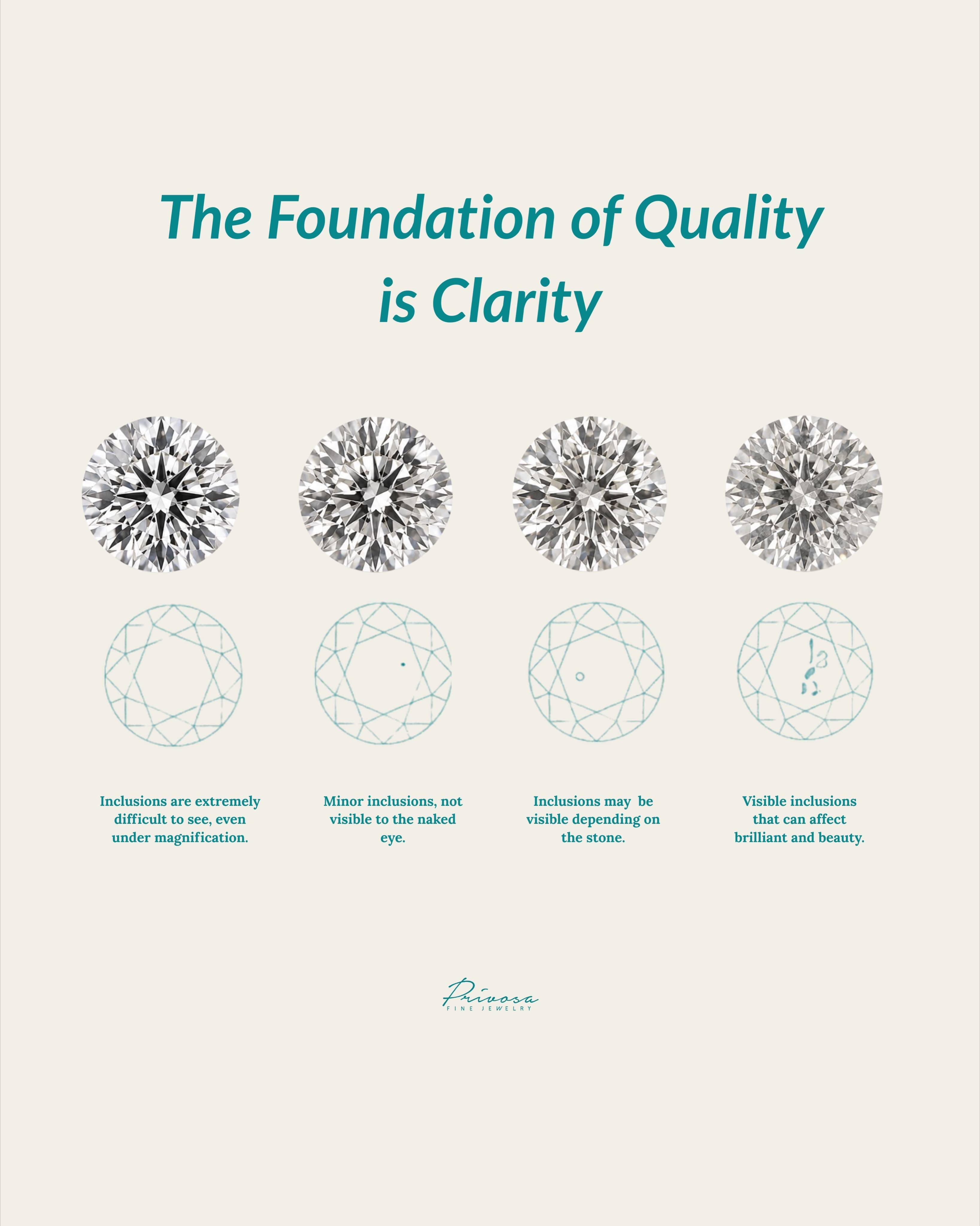
The eleven grades group into five broad tiers. Reading them as tiers, rather than memorizing every letter, is the fastest way to understand what you are looking at.
- FL, Flawless
- No inclusions or blemishes visible under 10x magnification. The rarest grade.
- IF, Internally Flawless
- No inclusions under 10x; at most minor surface blemishes.
- VVS1 to VVS2, Very Very Slightly Included
- Minute inclusions that are difficult for even a skilled grader to see under 10x.
- VS1 to VS2, Very Slightly Included
- Minor inclusions, hard to see under 10x and effectively invisible to the naked eye.
- SI1 to SI2, Slightly Included
- Inclusions noticeable under 10x, but frequently still eye-clean when viewed face-up.
- I1 to I3, Included
- Inclusions obvious under magnification and typically visible to the unaided eye.
Finding the sweet spot: VS to SI
Here is what actually matters when you are shopping. Diamonds in the VS to SI range are the sweet spot for most buyers. They are eye-clean, meaning their inclusions are invisible without magnification, yet they cost meaningfully less than the Flawless and Internally Flawless grades whose perfection you would need a loupe to appreciate. The eye cannot tell the difference, but the budget can.
- Ask whether the stone is eye-clean, a plain-language question that matters more than the letter grade itself.
- Look at the diamond face-up in person or in a high-resolution image before deciding.
- Remember that larger stones show inclusions more readily, so a step up in clarity can be worth it as carat weight rises.
- Clarity works alongside the other three of the 4Cs; a well-cut SI stone often outshines a poorly cut higher grade.
Frequently asked
What is the best diamond clarity grade to buy?+
For most buyers the VS to SI range offers the best balance. Diamonds in this range are typically eye-clean, meaning inclusions are invisible without magnification, while costing far less than Flawless or Internally Flawless grades that look identical to the naked eye.
What is the difference between an inclusion and a blemish?+
Inclusions are internal features that formed while the diamond crystallized, such as tiny crystals or feathers. Blemishes are surface features like scratches or nicks. The GIA weighs both when assigning a clarity grade.
Does clarity affect a diamond's sparkle?+
Clarity mainly affects transparency and appearance rather than sparkle, which is driven mostly by cut. Only at the lower grades, where inclusions are large or numerous, can clarity begin to dull a diamond's brilliance.