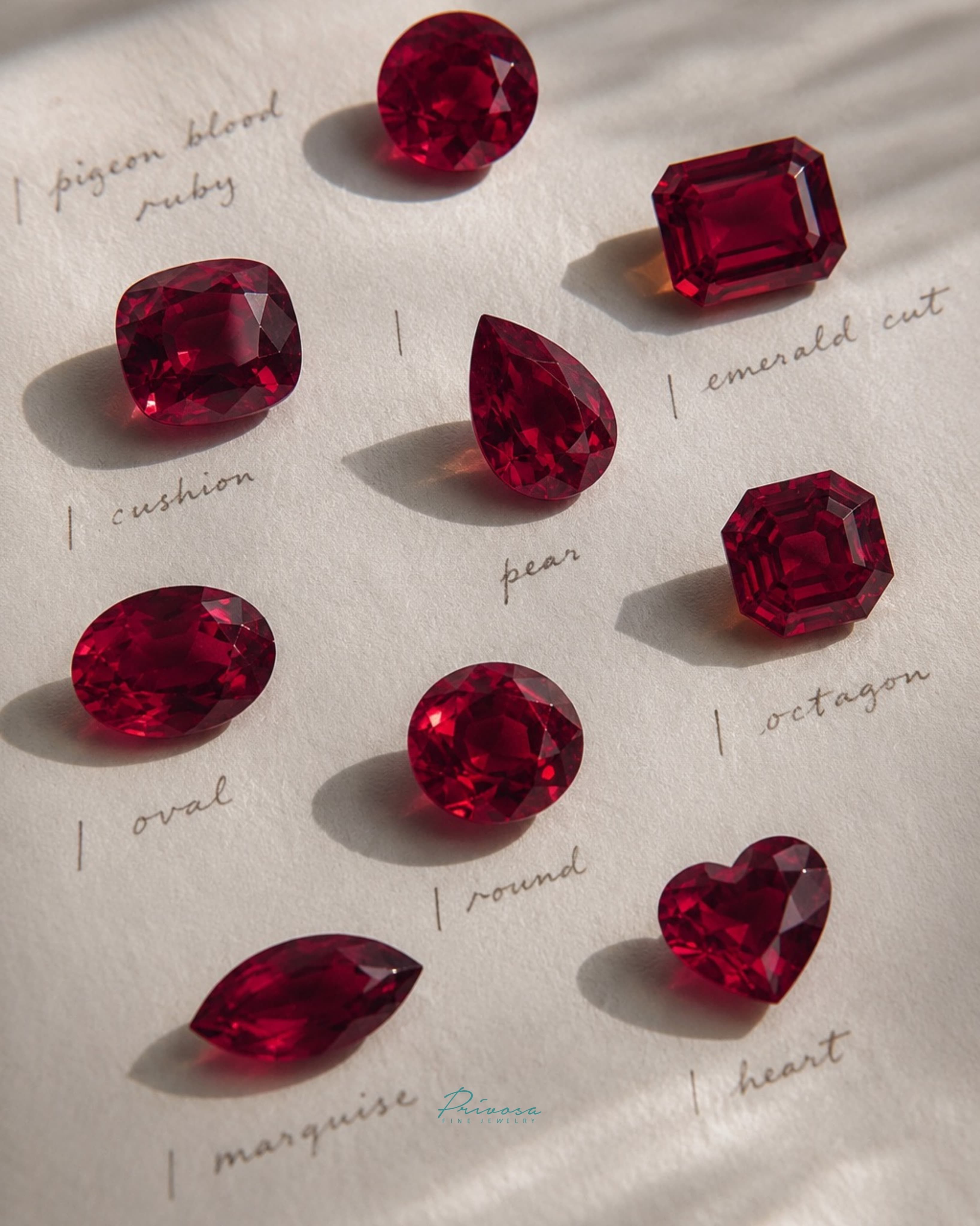
A pigeon blood ruby never looks the same twice. The red at its heart is constant, deep, saturated, unmistakable, but the way that red reaches the eye depends almost entirely on how the stone is cut. In an emerald cut it feels powerful. In a pear, romantic. In a cushion, timeless. Same gemstone, different energy.
That is the quiet lesson in a fine ruby: shape is not just an outline. It decides how light travels through the stone, how evenly the color returns, and how the piece carries itself on the hand. Here is what pigeon blood means, how three classic cuts change a ruby's character, and how to read quality once the color has caught your eye.
What pigeon blood really means
Ruby is the red variety of corundum, the same mineral that gives us sapphire. A trace of chromium is what turns it red, and the more chromium, the more vivid the color, sometimes strong enough to make the stone glow, or fluoresce, in daylight. Pigeon blood is the traditional name for the most prized version of that red: a pure, intense crimson with only the faintest hint of blue, and no brown or orange to dull it.
The term began with the finest rubies from Burma, now Myanmar, and it has always described color rather than origin. It sits at the top of the scale, the red that colored-stone buyers reach for first.
How the cut changes the character
Cut, in a colored stone, means two things at once: the shape of the outline and the arrangement of the facets. Step cuts, like the emerald, use long parallel facets that read as clean lines and quiet depth. Brilliant-style cuts, like the pear and the round, use many small triangular facets that break light into sparkle. Neither is better. They simply give the same red a different voice.
Three classic ruby cuts, and two more to know
- Emerald
- A step cut with long, straight facets and cropped corners. Architectural and composed; it reads as power, and rewards a stone with strong, even color.
- Pear
- A teardrop that blends round and marquise. Elongating and soft, with a pointed tip and rounded base, the most romantic of the shapes.
- Cushion
- A squared shape with rounded corners and broad facets. Its gentle outline and warm glow feel timeless and a little vintage.
- Oval
- A rounded, elongated brilliant. Flattering and versatile; the curve can make the color look larger and more lively on the finger.
- Round
- The most symmetrical brilliant. Returns color and sparkle evenly from every angle, though it uses more of the rough stone.
This is why the caption holds true. The ruby has not changed, only the cut has, and with it the whole mood of the piece.
Reading a ruby's quality
Diamonds are graded first on cut and clarity. Rubies are graded first on color. Once the red has your attention, four things tell you how fine the stone really is.
- Color is paramount. Look for a rich, even red; jewelers describe it in terms of hue, tone, and saturation. The pigeon blood standard sits at a vivid, medium-dark red with no muddy secondary color.
- Clarity is judged gently. Rubies almost always carry inclusions, including fine needles called silk. A few are expected; an eye-clean ruby of top color is rare and valued accordingly.
- Cut controls the color. A well-cut stone returns light evenly, with no dark or washed-out patches, and holds its color face-up rather than leaking it out the sides.
- Carat weight raises the price sharply. Fine rubies are far rarer than diamonds at larger sizes, so price per carat climbs quickly as the stone grows.
One more thing to expect: most rubies are heat-treated to improve color and clarity. It is a stable, long-accepted practice. Untreated stones of fine color do exist, and they command a premium, so it is always worth asking.
Frequently asked
What does pigeon blood mean for a ruby?+
It describes the most prized ruby color: a vivid, pure red with a faint bluish undertone, no brown or orange, and often a strong fluorescent glow. The term originated with fine rubies from Burma, now Myanmar, and refers to color rather than where the stone was mined.
Does the cut change a ruby's value?+
The shape itself does not set the grade, since color is the leading factor in rubies. But a well-executed cut controls how evenly color and light return across the stone and whether it holds its color face-up, which affects both beauty and price.
Are rubies usually treated?+
Yes. Most rubies on the market are heat-treated to improve color and clarity, a stable and widely accepted practice. Untreated stones of fine color are rarer and command a premium, so it is worth asking about treatment before you buy.