
Rubies exist across a breathtaking spectrum of color, and each hue tells a different story. While rubies come in countless natural variations, a handful of shades have long been the most sought-after in the world of fine gemstones. Learning to read those shades is the first real step in understanding what you are looking at.
With most gemstones, several factors compete for your attention. With ruby, one factor leads all the others: color. It is the quality that draws the eye across a room, and it is the quality that quietly determines how rare a stone truly is.
Why color defines a ruby
A ruby is the red variety of corundum, the same mineral species as sapphire. What makes it red is a trace amount of chromium sitting inside the crystal. A little chromium gives a gentle pinkish red; more of it deepens the stone toward a rich, saturated red. That single element is the reason ruby and sapphire, chemically near-identical, look nothing alike.
Gemologists describe a stone's color in three parts. It helps to hold all three in mind at once, because a beautiful ruby is a balance of them rather than a single measurement.
- Hue: the color itself, and whether it leans toward pink, pure red, or orange.
- Tone: how light or dark the stone appears, from bright to deep.
- Saturation: the intensity or purity of the color, from muted to vivid.
The most prized rubies tend to sit in a pure, vivid red with a medium to medium-dark tone. Too light and the stone reads as pink; too dark and the color can lose its glow.
The most sought-after ruby hues
Within that spectrum, a few shades stand apart. These are the reds that collectors and jewelers return to again and again.
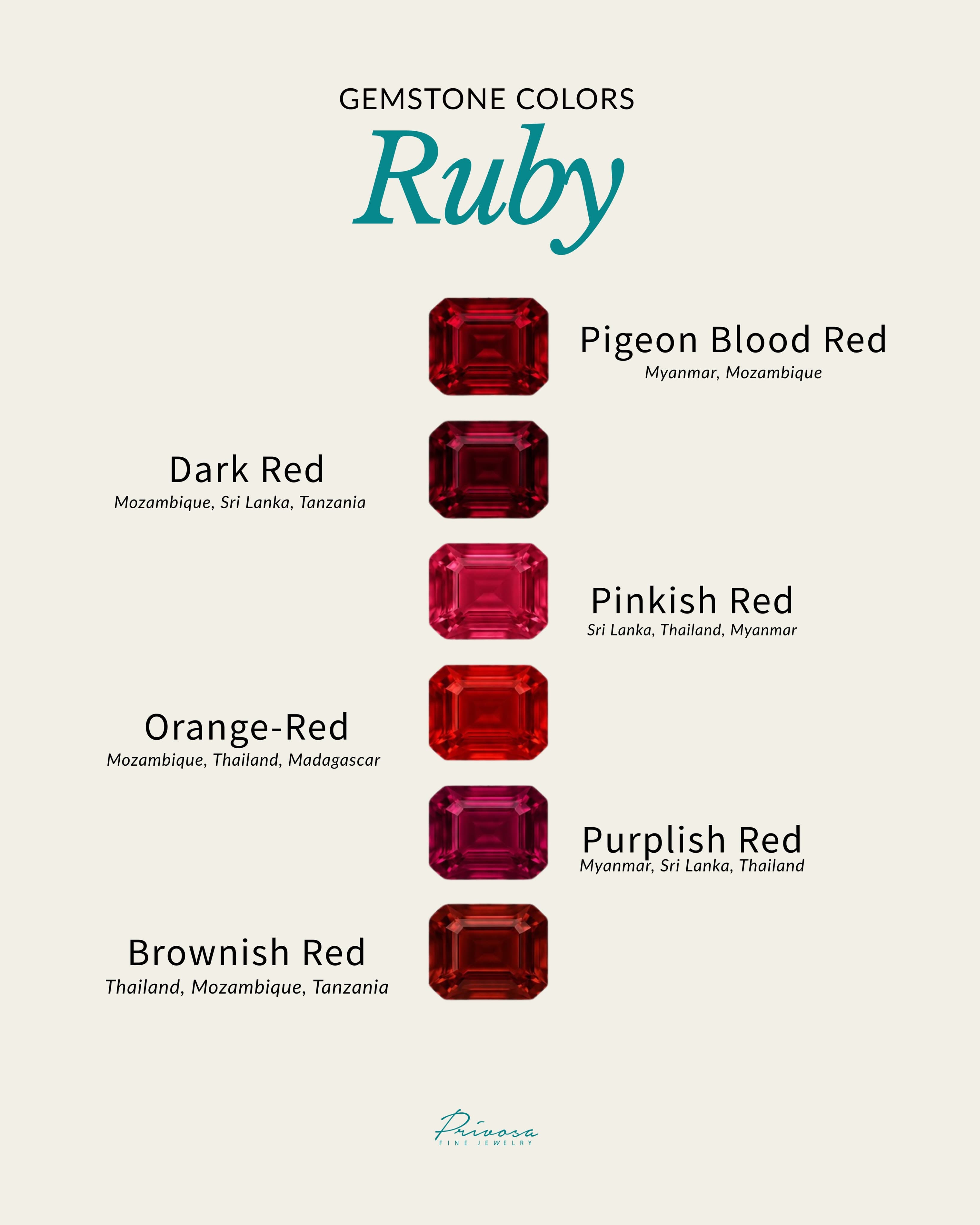
- Pigeon Blood Red
- The rarest and most coveted of all. A traditional trade term for a pure, intense red with a subtle blue undertone, historically associated with the finest Burmese stones.
- Dark Red
- Deep, rich, and timeless. A saturated red that reads as classic and formal, with weight and presence in the hand.
- Pinkish Red
- Delicate yet undeniably powerful. A lighter, softer red that stays unmistakably ruby, bright and romantic in feel.
- Orange-Red
- Warm, vivid, and full of character. A red with a glowing, sunlit edge that feels lively rather than austere.
None of these is the single correct choice. Pigeon blood commands the highest rarity, but a warm orange-red or a soft pinkish red can be exactly the stone that suits a particular hand, skin tone, or setting. The right hue is the one you are drawn back to.
Living with a ruby
Ruby is not only beautiful, it is tough. On the Mohs scale of hardness it sits at 9, second only to diamond among gems you are likely to wear. That durability is why ruby has been set into rings and worn daily for centuries, and why it holds up well as a center stone rather than an occasional piece.
- Because color is so central, view a ruby in more than one light before deciding. Daylight and indoor light can shift how the red reads.
- A secure setting protects the stone and lets its color sit forward, which is where a ruby wants to be.
- Clean gently with mild soap and warm water; ruby's hardness makes routine care simple.
Frequently asked
What is a pigeon blood ruby?+
Pigeon blood is a traditional trade term for the finest ruby color: a pure, intense red with a subtle blue undertone, historically linked to the best Burmese stones. It is the rarest and most coveted shade, which is why it commands the highest value.
What actually makes a ruby red?+
Ruby is the red variety of the mineral corundum, the same species as sapphire. Its red comes from trace amounts of chromium in the crystal; more chromium produces a deeper, more saturated red.
Is a ruby durable enough for everyday wear?+
Yes. Ruby ranks 9 on the Mohs hardness scale, second only to diamond among common gems, which makes it well suited to rings and jewelry worn day to day.