
Not all engagement rings sit the same, and that is intentional. The profile of a setting — how high or low the center stone rests above your finger — shapes how a ring catches the light, how it feels across a long day, and how it wears over the years you will spend in it.
It is one of the quieter choices in a ring, and one of the most consequential. Here is what profile means, the options you are likely to meet, and how to weigh them against the way you actually live.
What a profile actually means
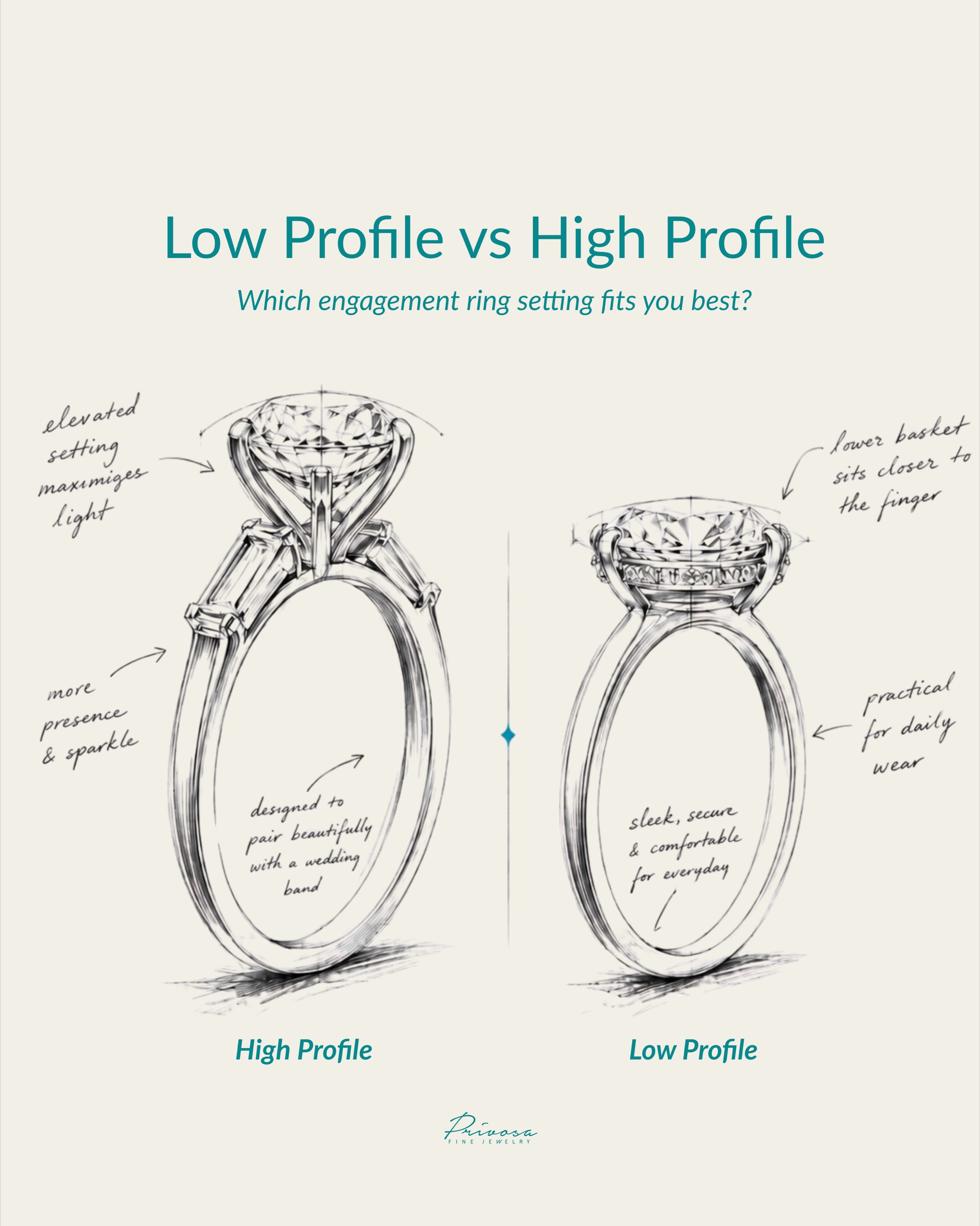
Look at a ring from the side rather than from above. That silhouette — the distance from the band to the top of the stone — is its profile. From the top, two rings can look nearly identical. In profile, one may sit almost flush to the finger while the other stands well clear of it.
Profile is set by the height of the head that holds the stone and the architecture beneath it. None of it changes the diamond itself. What changes is how the stone meets your hand: how much light reaches it from the sides, how it clears a glove or a pocket, and how it feels when you close your fist.
The three profile heights
Most settings fall into one of three broad heights. There is no better or worse among them, only what suits your hand and your habits.
- Low profile
- The stone sits close to the finger. This is the most secure and snag-resistant option, lies flat under gloves, and slips easily beneath cuffs and pockets — a natural fit for hands-on days.
- Medium profile
- A balanced middle ground that lifts the stone enough to let light enter from the sides while keeping it reasonably close to the hand. The most versatile choice for most wearers.
- High profile
- The stone is raised well clear of the band. It catches light from more angles and reads prominent and dramatic, but it stands proud and is more likely to catch on fabric or knock against surfaces.
How the setting shapes the height
The setting style you choose largely decides where your ring lands on that scale. A few of the most common:
- Prong
- Metal claws lift and cradle the stone, opening it to light from the sides. How tall the head sits determines much of the overall profile.
- Cathedral
- Arches of metal rise from the band to meet the stone, adding height and extra support with a graceful, architectural line.
- Bezel
- A rim of metal wraps the stone around its girdle. It is one of the lowest and most protective profiles, with clean, modern edges.
- Basket
- A woven cradle of metal beneath the stone. It can lower the seat and bring the diamond closer to the hand while still letting light through.
Choosing for the way you live
Because you will wear this ring nearly every day, the practical questions matter as much as the aesthetic ones. A few worth sitting with:
- How active are your hands? Frequent lifting, gardening, or gym work favors a lower, more protected profile.
- Think about gloves, keyboards, and small children — anything a raised stone might catch on or press into.
- Consider proportion. A higher profile can lend presence to a smaller stone and elongate the look of the finger.
- Factor in the wedding band. A tall or cathedral setting may need a contoured band to nest against it neatly.
- Try profiles on before you commit. The same stone can feel like two different rings at two different heights.
Frequently asked
Which ring profile is best for an active lifestyle?+
A low-profile setting — such as a bezel or a low-set prong — keeps the stone close to the hand, which reduces the chance it snags on clothing or knocks against surfaces. It also sits more comfortably under gloves and through hands-on work.
Does a higher setting make a diamond look bigger?+
A raised setting can make a stone appear more prominent because it stands away from the finger and catches light from more angles, but it does not change the carat weight. A high profile draws the eye; it does not add size.
Will my engagement ring's profile affect the wedding band?+
Sometimes. A very high or cathedral setting can leave a small gap against a flat band, so some couples choose a contoured or notched band that nests neatly beneath the center stone. It is worth checking the pairing before you decide.