
A ring is a small piece of architecture. Once you can name its parts, the whole object becomes easier to read, and easier to judge. Understanding how a ring is built is the difference between choosing on looks alone and choosing craftsmanship meant to last a lifetime.
Knowing your ring anatomy is not only for experts. It is the quiet groundwork of a smart decision: the vocabulary that lets you ask better questions, compare two rings fairly, and understand exactly what you are looking at.
The anatomy of a ring, part by part
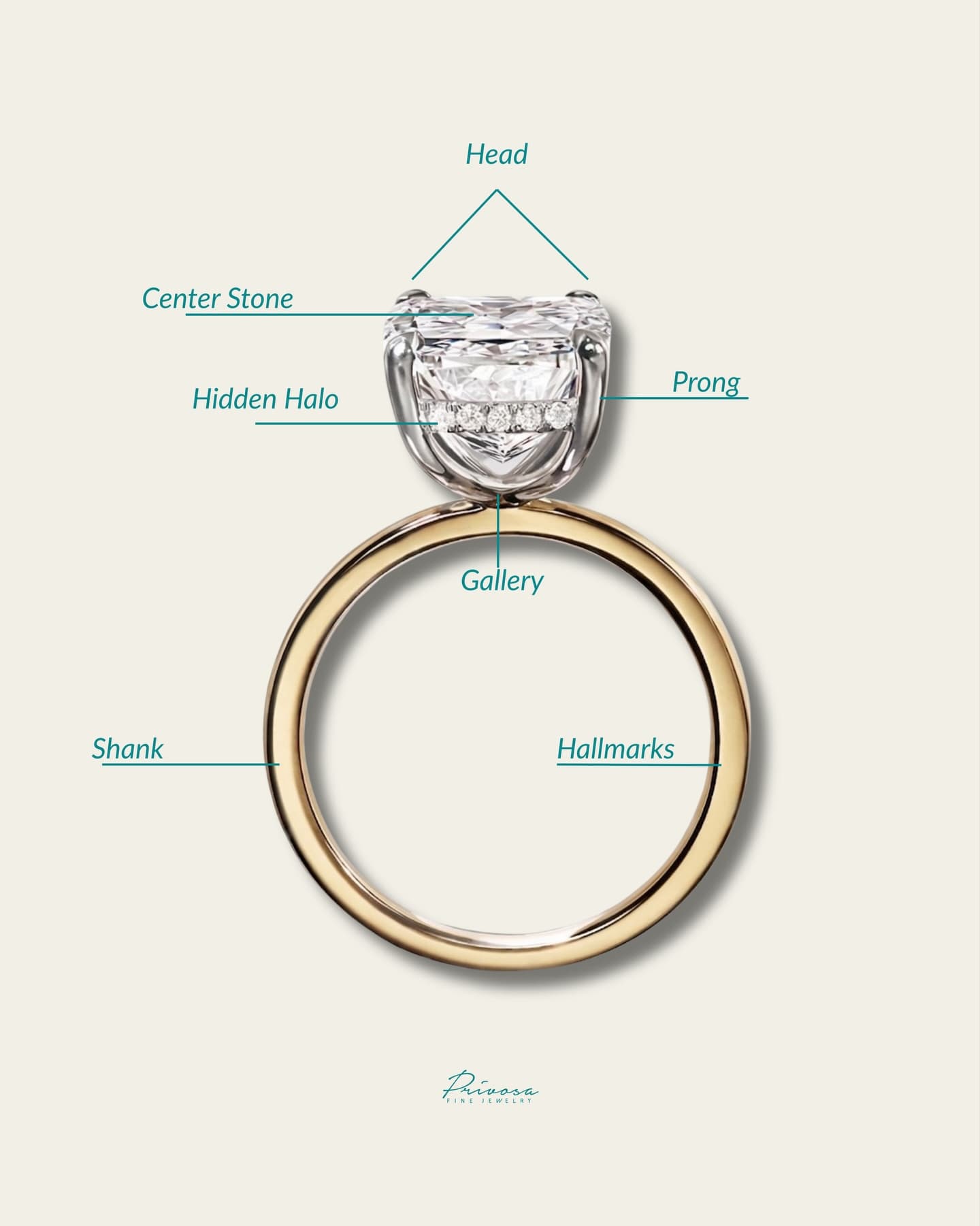
Most rings share the same core elements. Here is what each one does, working from the stone at the top down through the structure that supports it.
- Center stone
- The heart of the ring: the focal gem the whole design is built around, most often a diamond, positioned to catch and return the most light.
- Prongs
- The slender metal claws that grip the stone and hold it in place. Because they leave the gem open on the sides, they let light enter from every angle. Four and six prongs are the most common.
- Hidden halo
- A discreet circle of small diamonds set just below the center stone. It is unseen from directly above, adding a secret flash of brilliance when the ring is viewed from the side.
- The gallery
- The open metalwork beneath the center stone. It is the architecture that connects the setting to the band, carries the weight of the stone, and gives the ring its side profile.
Why the setting is a craftsmanship decision
The setting does two jobs at once. It has to hold the stone securely for decades of daily wear, and it has to stay out of the light so the gem can do its work. How well a maker balances those two demands tells you a great deal about the quality of the piece.
- Prong count is a trade-off. Six prongs offer a little more security and a rounder look; four prongs show more of the stone and read cleaner. Neither is simply better, but both should be even, smooth, and tight against the gem.
- Prongs are a maintenance point. Over years of wear they can thin or loosen, so they should be checked periodically and re-tipped if needed. Well-made prongs make that easy.
- The gallery is where craftsmanship hides. Clean, symmetrical metalwork underneath signals care; it also keeps the ring comfortable and lets you clean beneath the stone.
- A hidden halo adds sparkle without raising the stone's silhouette, so the center gem still looks like the star from above.
What to look at before you commit
Once you know the parts, a quick, unhurried inspection tells you most of what you need. Turn the ring in the light and look from more than one angle.
- View it from the side, not just the top: the gallery and any hidden halo only reveal themselves in profile.
- Check that the prongs sit flush and even, with no snags and no daylight between metal and stone.
- Confirm the center stone sits level and centered, and that the metal beneath it is finished as neatly as the parts you see first.
- Ask what the stone is and how it is graded; the setting is only as good as the gem it protects.
Frequently asked
What is a hidden halo on a ring?+
A hidden halo is a small circle of diamonds set just beneath the center stone, below the point where the prongs meet the setting. You cannot see it from directly above, but it adds extra sparkle when the ring is viewed from the side.
What is the gallery of a ring?+
The gallery is the open metalwork underneath the center stone. It connects the setting to the band, supports the weight of the gem, gives the ring its side profile, and leaves space to clean beneath the stone.
Are four prongs or six prongs better?+
Both are common and reliable. Six prongs give a little more security and a rounder outline, while four prongs show more of the stone and look cleaner. What matters most is that the prongs are even, smooth, and tight against the gem.